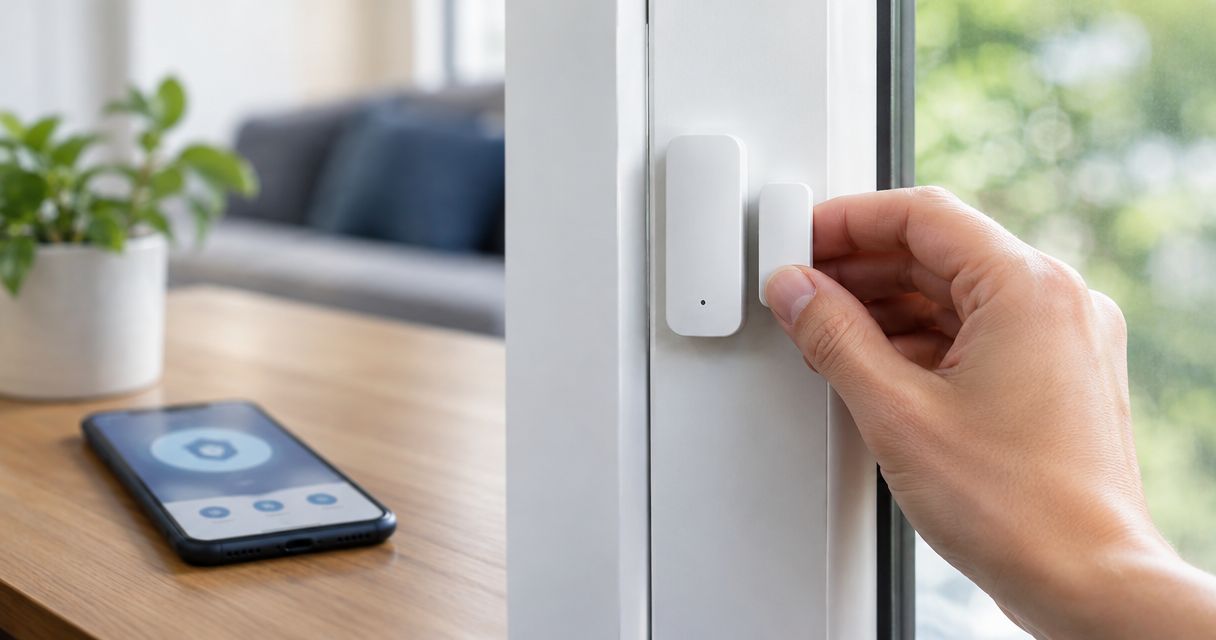
Yes. A magnetic reed switch sensor can cause false alarms when the magnet moves out of alignment, the door shifts, the contact fails, or the alarm circuit develops a fault. The alarm panel can also report a wiring, tamper or wireless fault that looks like a faulty door sensor. Check the recorded event and the door fit before replacing the contact.
- A magnetic reed switch false alarm needs checks of alignment, door movement, wiring and panel events before replacement.
- A closed door does not prove that its magnet sits within the contact’s specified operating gap.
- Wireless door contacts add battery and radio checks; the reed switch itself does not require a battery.
- Patsec Security Store supplies intruder alarm equipment and installation for homeowners and businesses in Nairobi.
Can a magnetic reed switch sensor cause false alarms?
Yes. A door contact reports a change in its magnetic or electrical state, not proof of an intruder. Your first task is to establish which event the panel actually recorded. For wider equipment planning, see the guide to intruder alarm systems in Kenya.
| Possible fault | Supporting observation | Next check |
|---|---|---|
| Magnet misalignment | Zone changes when you press the closed door | Compare mounting positions with the contact instructions |
| Door or window movement | Events coincide with movement of the closed opening | Inspect hinges, latch and frame |
| Cable or terminal fault | Zone changes without corresponding door movement | Have the circuit inspected and tested |
| Tamper activation | Panel records a tamper event | Check the housing and tamper arrangement |
| Wireless fault | Panel records battery or communication trouble | Follow the transmitter’s diagnostic instructions |
| Failed contact | Contact remains intermittent after installation faults are excluded | Test the isolated contact before replacement |
An unexplained alarm is not automatically a false alarm. Check the premises safely and follow your security response procedure before treating the event as an equipment fault.
Why this matters
Replacing a working contact does not correct a moving door, damaged cable or incorrect panel setting. The same alarm can return after the new device is fitted, leaving you with an unresolved fault.
For a 2026 security maintenance record, keep the zone name, event type and circumstances together. A clear record helps your installer distinguish a door-opening event from a tamper or communication fault without relying on memory.
A reed contact also has a specific limitation: it monitors the opening at its installation point. It does not provide general motion detection or prove that the whole room is secure.
Check these causes before replacing the sensor
The causes of a magnetic reed switch false alarm fall into distinct groups. Use the evidence from the affected opening rather than changing several settings at once.
- Magnet position: A magnet mounted near the contact’s switching threshold leaves little allowance for movement. Follow the model’s alignment markings and specified gap.
- Door fit: Loose hinges, a poor latch or a flexible frame lets the closed door move relative to the contact. Repair the opening rather than compensating for it with alarm settings.
- Mounting surface: Steel affects the magnetic field around a contact. Use a device and mounting arrangement approved for that surface.
- Wiring condition: Loose connections, damaged insulation and moisture affect a wired alarm circuit. The panel’s response depends on its circuit supervision and programming.
- Housing and transmitter faults: A disturbed cover can operate a tamper switch. Wireless contacts also require separate battery and communication checks.
- Contact or configuration faults: A damaged reed switch or a mismatch between the circuit and zone settings needs testing against the equipment instructions.
Do not assign a cause from timing alone. An event during windy weather directs attention to movement, but it does not establish that movement caused the alarm.
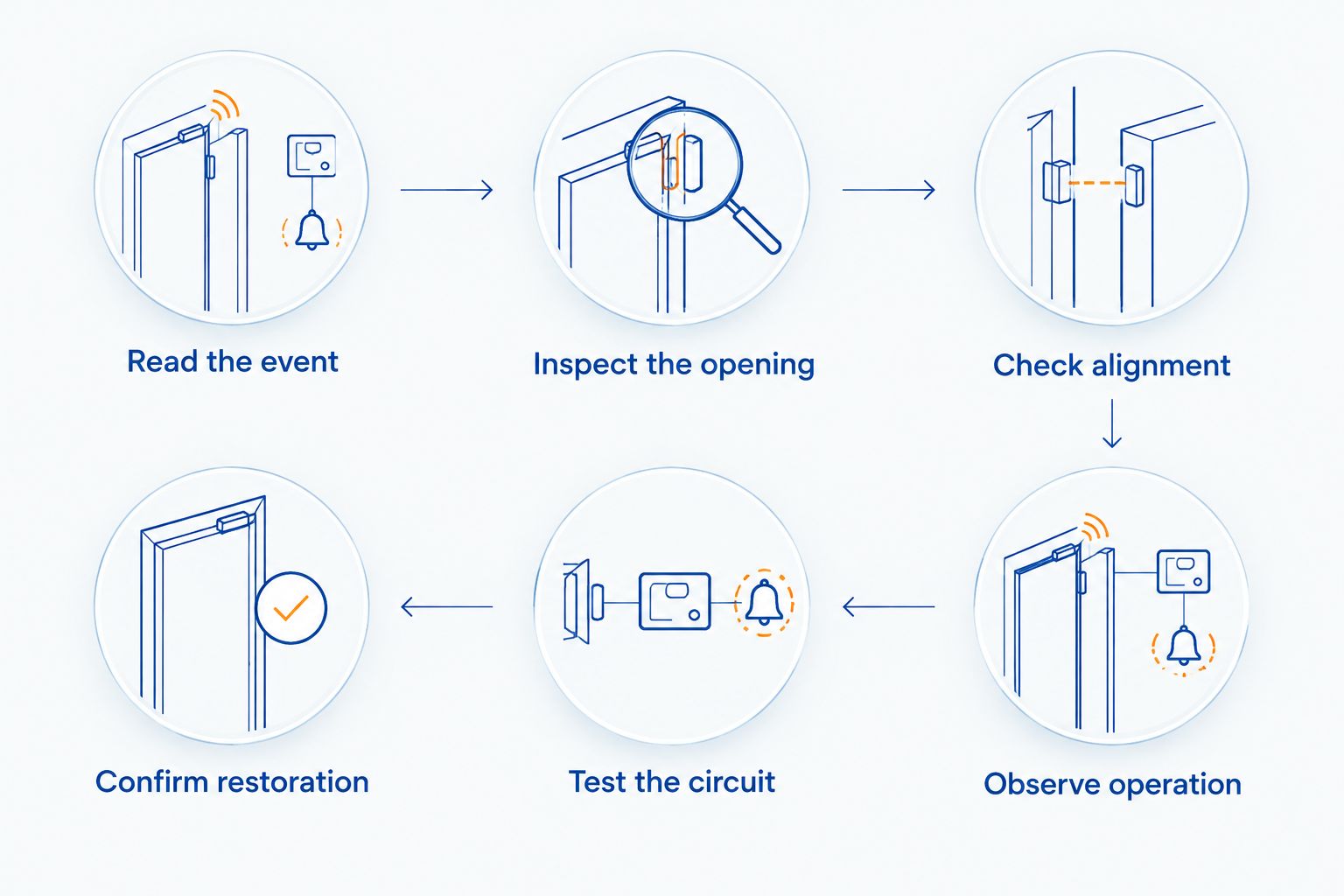
How do you find the source of a magnetic reed switch false alarm?
Use a controlled test that separates the opening, contact and alarm circuit. Tell anyone responsible for receiving alarm signals before testing, and follow the panel or monitoring provider’s test procedure.
1. Read the event
Record the exact zone and event description before clearing the display. Look for distinctions such as alarm, tamper, low battery and communication trouble; the available wording depends on the panel.
In your 2026 fault log, note whether the system was armed and whether anyone operated the door. Do not describe every notification as an intrusion alarm when the panel identifies a different fault.
2. Inspect the opening
Close and latch the door normally. Look for loose screws, a detached magnet, damaged housings and a door that no longer sits squarely in its frame.
Gently check the movement available while the door remains latched. If the zone changes while the closed door moves within its frame, investigate the mounting geometry and door fit before buying another contact.
3. Check alignment
Find the model identification and installation instructions. Compare the magnet’s position, orientation and separation with the manufacturer’s requirements, including any instructions for metal frames.
There is no universal gap to apply to every magnetic contact. Do not copy a measurement from another installation or assume that a stronger magnet is an approved repair.
4. Observe operation
With the system in its approved test mode, open and close the door while observing the relevant zone indication. Check that normal opening registers and normal closure restores the zone.
Repeat the check with the door fully latched, not held shut by hand. A successful hand-held test does not demonstrate that the installed door remains stable during normal use.
5. Test the circuit
Have a competent installer check terminals, cable condition, supervision components and zone configuration. Electrical testing must follow the panel instructions; resistance testing is for an appropriately isolated circuit, not a live panel connection.
For wireless equipment, check the transmitter’s battery indication, housing and communication diagnostics. A battery or radio fault does not, by itself, prove that the reed element has failed.
6. Confirm restoration
After correction, verify normal opening detection, closed-door stability and any applicable tamper function. End test mode correctly and confirm that the system has returned to its intended operating state.
Record the correction and result in the 2026 maintenance log. Do not leave the zone bypassed as the permanent solution to nuisance alarms.
Which replacement contact should you choose?
Choose a replacement for the panel, opening and environment, not just its appearance. Patsec Security Store supplies security equipment and installation; provide the existing contact and panel details when discussing a replacement.
| Contact arrangement | Best for | Main advantage | Limitation to check |
|---|---|---|---|
| Wired contact | An opening with a suitable existing cable route | The basic reed contact needs no battery | Cable faults and circuit compatibility still require testing |
| Wireless contact | A compatible alarm system where new cabling is impractical | Avoids running a new contact cable | Requires compatible radio equipment, batteries and communication checks |
| Surface-mounted contact | An opening where visible mounting is acceptable | Accessible for inspection and adjustment | Exposed housings need secure, suitable mounting |
| Recessed contact | A suitable door and frame where concealed fitting is required | Keeps the contact largely concealed | Requires appropriate drilling and a permitted mounting position |
These categories overlap: a surface-mounted contact can also be wired. They describe installation choices, not a ranking of detection reliability.
Keep a serviceable contact when the actual fault is the door or cable. Replace a contact when testing identifies failure, physical damage or an unsuitable installation type. Check suitability for steel surfaces, outdoor exposure and the panel’s circuit requirements before ordering.
What details should you give the supplier or installer?
A useful replacement enquiry identifies the installation, not simply the symptom. Patsec Security Store intruder alarm equipment enquiries should include the panel model, contact model if readable, and whether the device is wired or wireless.
Prepare the following before your 2026 repair visit:
- A clear description of the panel event and affected zone.
- Photographs of the contact, magnet and mounting positions.
- The door or window material and whether the frame is metal.
- Details of visible damage, recent door work or water exposure.
- Any measurements requested by the contact’s installation instructions.
- Whether other devices share the affected wired zone.
Do not assume that a physically similar wireless contact will pair with your panel. Compatibility includes the supported communication protocol, not just the operating frequency or housing shape.
Ask for the proposed fault correction as well as the replacement specification. That keeps a door adjustment, cable repair or configuration correction separate from the decision to buy a new device.
What can a magnetic door contact fail to detect?
A magnetic reed contact detects the relationship between its switch and magnet. It does not detect every route into a property, and it does not directly detect movement elsewhere in the room.
A window contact can remain closed if glass breaks without moving the monitored sash. Choose additional detection according to the actual security risk rather than expecting a door contact to perform another sensor’s job.
A magnetic lock is also different from a magnetic contact: the lock secures the opening, while the contact reports its state. Where both are installed, assess the alarm event separately from the lock’s power behaviour. The guide to magnetic door locks during a power outage explains that separate issue.
How do you maintain a magnetic door contact?
Include the contact whenever you inspect the door hardware. Check secure mounting, housing condition, alignment and the way the opening closes; follow the manufacturer’s instructions for functional testing.
After hinge replacement, repainting, frame repairs or contact removal, test the zone again. A contact that worked before the work still needs verification once its mounting relationship changes.
For wireless devices, follow the specified battery replacement and disposal instructions. Do not substitute a battery solely because it fits inside the housing.
Keep the 2026 maintenance entry specific: identify what changed and whether the alarm registered both opening and restoration. Avoid recording only that the device was checked, without the test result.
Should you bypass a contact that keeps alarming?
Do not treat bypassing as a repair. A bypass removes that zone from the system’s normal protection according to the panel’s configuration, leaving the affected opening without its intended detection.
If temporary isolation is necessary, follow the authorised procedure and arrange correction. Anyone responsible for securing the premises needs to know which protection is unavailable and when it is restored.
Do not bridge terminals, relocate supervision resistors or disable tamper protection to silence the fault. Those changes can conceal the original problem and undermine circuit monitoring.
FAQ
Can a magnetic reed switch trigger an alarm when the door is closed?
Yes. A closed door can still let the magnet move outside the contact’s operating position, and a wiring or tamper fault can produce a separate event. Check the panel log before deciding which fault to investigate.
What gap should I leave between a door contact and its magnet?
Use the operating gap and alignment specified for that contact model. Mounting material and orientation matter, so there is no universal measurement suitable for every installation.
Can a low battery cause a magnetic door sensor problem?
A low battery can affect a wireless door sensor’s transmitter and produce a battery or communication warning. The basic reed switch itself does not need a battery; check the panel’s exact event description.
Can a metal door affect a magnetic reed contact?
Yes. Steel affects the magnetic field around a contact, so the contact and mounting arrangement must be suitable for the surface. Follow the manufacturer’s instructions for metal doors and frames.
Should I replace the sensor after one unexplained alarm?
Do not replace the sensor solely because an alarm occurred. First check the premises, event history, door movement, alignment and circuit condition, then replace equipment if testing identifies a fault.
Can I use any wireless door contact with my alarm panel?
No. A wireless door contact must support the alarm panel’s compatible communication system. A similar housing or matching frequency alone does not establish compatibility.
Will a magnetic window contact detect broken glass?
A magnetic window contact does not directly detect glass breakage. It detects the monitored opening changing state, so broken glass without sash movement can leave the contact closed.
One last thing
Test the contact with the door latched, then check the movement still available in that position. A door that appears closed can move enough to change the contact state. Correct that mechanical relationship before blaming the electronics.
Related guides
- Planning a home security system in Kenya
- Is a wireless panic alarm reliable for home security?
- Can I install an access control system myself?