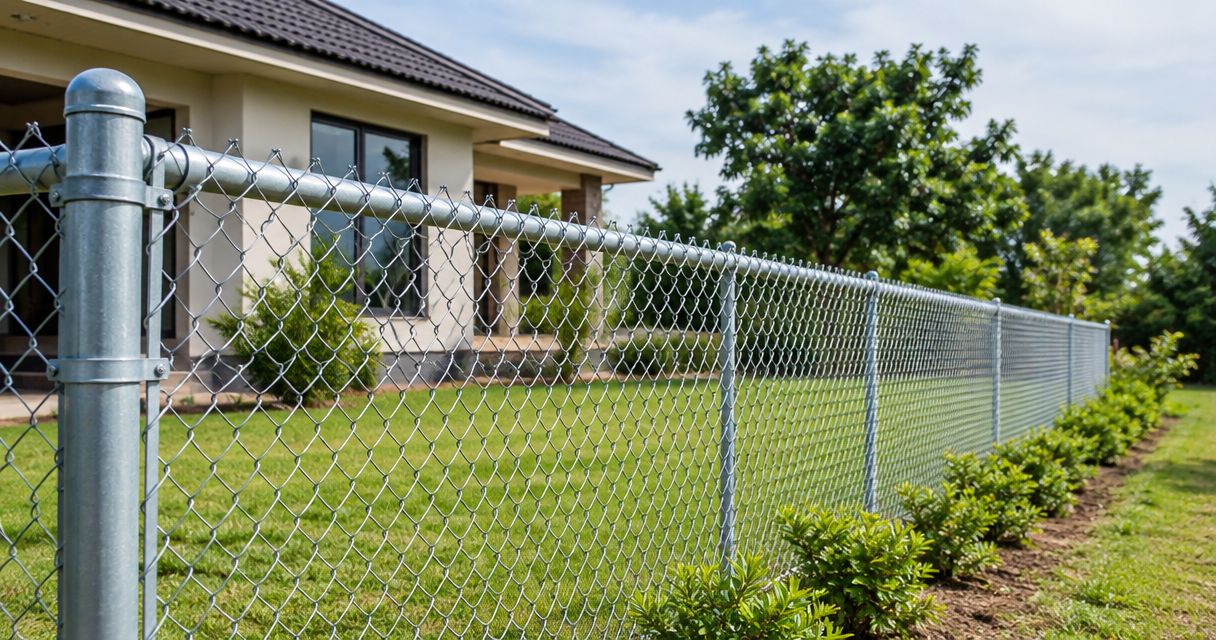
Best default: galvanised chain-link fencing on steel posts. Best for permanent supports: concrete-post fencing. Best for a coloured finish: PVC-coated mesh. When comparing chain link fence price in Kenya, choose the full installed specification—not the mesh roll alone.
- For chain link fence price in Kenya, compare installed fencing specifications rather than mesh rolls alone.
- Galvanised chain-link fencing on steel posts is the default recommendation for an open residential boundary.
- Concrete posts suit permanent supports; PVC-coated mesh suits buyers who want a coloured finish.
- Patsec Security Store supplies security equipment and installation services for homeowners and businesses.
- Chain-link mesh provides a physical boundary, not privacy or an intrusion alarm.
Why the installed specification matters
Chain-link fencing defines your compound while keeping sightlines open. It does not provide the privacy of a solid wall, and ordinary mesh does not report cutting or climbing.
A useful 2026 buying comparison separates the mesh from the supporting structure. Two quotations can describe chain-link fencing while including different posts, foundations, gates and installation work.
Start with the chain-link fencing cost guide, then request a site-specific quotation. Compare the same boundary length, fence height, wire diameter and installation scope before choosing.
What makes the best chain-link fencing?
The best residential configuration matches the boundary’s purpose and the conditions on site. Use these criteria before choosing a finish or post material:
- Wire diameter: Ask for the actual diameter in millimetres, not a gauge description alone. Confirm whether a coated-wire measurement includes its outer coating.
- Mesh opening: Specify the opening size. Containment requirements differ from a boundary intended mainly to mark the property.
- Corrosion protection: Request the mesh and post coating specifications. Inspect cuts, fixings and damaged surfaces rather than judging protection by colour.
- Posts and foundations: Match supports, bracing and foundations to the fence design and ground conditions. Mesh alone is not a complete fence.
- Gates and ground clearance: Include pedestrian access, vehicle access and the bottom edge. A strong mesh specification does not correct a weak gate closure.
- Security purpose: Decide whether you need a visible boundary, animal containment, added deterrence or an alarm. These are different requirements.
Residential chain-link fencing at a glance
These options are configurations, not mutually exclusive product types. You can combine coated mesh with concrete posts, for example; the ranking identifies the main reason to choose each option.
| Rank | Configuration | Best for | Standout feature | Key limitation |
|---|---|---|---|---|
| 1 | Galvanised mesh on steel posts | A straightforward open boundary | Mesh and steel supports form a conventional fencing system | No privacy or intrusion detection |
| 2 | Chain-link mesh on concrete posts | Permanent post supports | Concrete supports avoid an exposed steel post body | Post handling and fixing details need planning |
| 3 | PVC-coated chain-link mesh | A coloured perimeter finish | An outer coating changes the mesh finish | Coating does not establish core-wire thickness |
| 4 | Smaller-aperture chain-link mesh | Animal containment | Smaller openings address a specific containment need | Bottom gaps and gates still matter |
| 5 | Chain-link fencing with separate electric topping | Layered perimeter deterrence | Combines a physical boundary with a separate electric system | Requires specialist design and ongoing checks |
1. Galvanised mesh on steel posts: best for a straightforward boundary
Galvanised chain-link mesh on steel posts is the default recommendation for a residential compound that needs an open boundary. The mesh closes the spaces between supports while preserving visibility through the fence.
Specify the posts, braces, tensioning components and gate structure alongside the mesh. Do not accept a quotation that names only the roll and leaves the supporting work undefined.
Galvanised steel-post fencing pros:
- Keeps views through the compound boundary open.
- Lets you specify mesh and support components separately.
- Suits a clear, functional perimeter without a solid wall.
Galvanised steel-post fencing cons:
- Provides no visual privacy.
- Requires attention to damaged protective finishes.
- Does not detect an intrusion by itself.
Best for: Homeowners who need a defined boundary and want to retain visibility.
Verdict: Buy as the baseline specification. Add upgrades only where the site or security requirement justifies them.
2. Concrete-post fencing: best for permanent post supports
Chain-link fencing on concrete posts changes the supporting structure rather than the mesh itself. It suits buyers who specifically want concrete boundary supports and accept the handling and fixing requirements.
Confirm how the mesh, straining components and gate connections attach to the posts. Concrete posts do not remove the need for sound foundations or properly supported corners.
Concrete-post fencing pros:
- Avoids an exposed steel post body along the boundary.
- Allows mesh selection independently of the post material.
- Provides a permanent support option for the fence layout.
Concrete-post fencing cons:
- Heavy posts complicate handling and positioning.
- Cracks and damaged fixing points need inspection.
- Gate supports still require a suitable design.
Best for: A permanent residential boundary where concrete supports are a deliberate requirement.
Verdict: Buy for the post requirement—not an assumed security advantage. Concrete supports do not make ordinary mesh impossible to cut or climb.
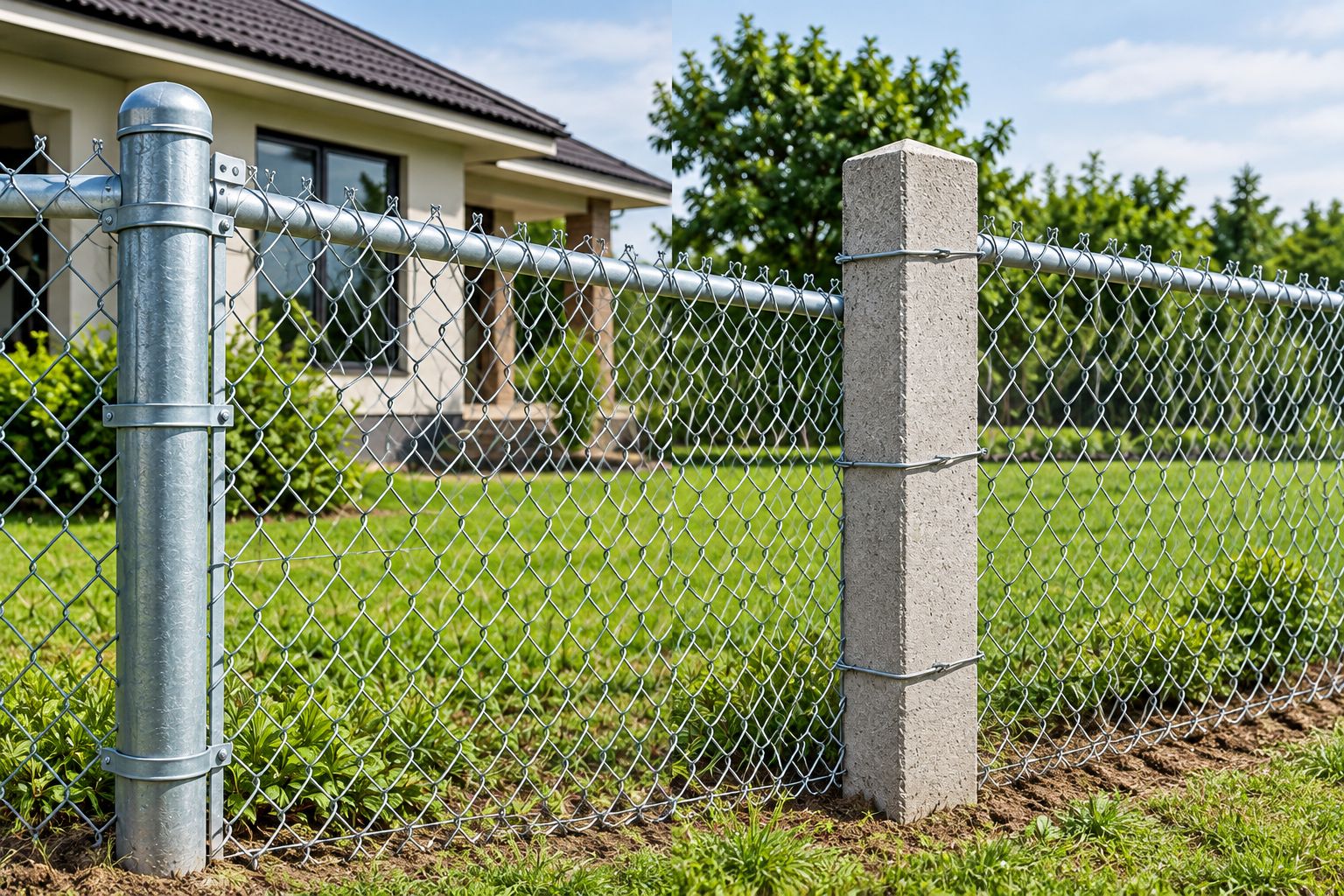
3. PVC-coated mesh: best for a coloured perimeter finish
PVC-coated chain-link mesh has an outer plastic coating over the wire. Choose it when you want a coloured finish, but assess the underlying wire and its protective treatment separately.
For a 2026 quotation, ask the supplier to distinguish core-wire diameter from overall coated diameter. A thicker-looking coated wire is not evidence of a thicker steel core.
PVC-coated mesh pros:
- Provides a coloured alternative to an exposed metallic finish.
- Retains the open structure of chain-link fencing.
- Adds an outer covering over the wire.
PVC-coated mesh cons:
- Outer diameter can obscure the core-wire comparison.
- Cuts and tears in the coating need attention.
- Colour does not establish structural strength.
Best for: Residential boundaries where the mesh finish is an explicit buying criterion.
Verdict: Buy for the finish after verifying the wire specification. Skip any comparison based on appearance alone.
4. Smaller-aperture mesh: best for animal containment
Smaller-aperture chain-link mesh reduces the size of the openings in the fence. Choose the opening around the animal you need to contain, rather than accepting an unspecified mesh pattern.
The bottom edge and gate clearances are equally important. Smaller openings do not solve a gap beneath the fence or prevent an animal from digging underneath it.
Smaller-aperture mesh pros:
- Addresses containment through the mesh openings.
- Preserves visibility across the boundary.
- Can be specified alongside the preferred post material.
Smaller-aperture mesh cons:
- Suitability depends on the animal and its behaviour.
- Ground gaps remain separate escape routes.
- Smaller openings do not prevent every climbing attempt.
Best for: Compounds where animal containment is the main reason for changing the mesh specification.
Verdict: Buy only against a defined containment requirement. Check the entire enclosure, not just the mesh panel.
5. Separate electric topping: best for layered perimeter deterrence
Chain-link fencing with separate electric topping combines a mesh boundary with an electric-fence system. The electric conductors require suitable supports, insulation, earthing and an energizer; ordinary chain-link mesh is not a substitute for that design.
Patsec Security Store supplies electric-fencing equipment and installation services. Request a site assessment before selecting the topping arrangement or connecting it to other security equipment.
Electric-topped chain-link fencing pros:
- Adds an electric deterrent above the physical boundary.
- Separates the mesh enclosure from the electric conductors.
- Allows the perimeter system to be assessed alongside other security measures.
Electric-topped chain-link fencing cons:
- Needs specialist installation and safety planning.
- Adds power, vegetation and fault-checking requirements.
- Does not remove weaknesses at gates or ground level.
Best for: Homeowners who need additional perimeter deterrence beyond an ordinary mesh boundary.
Verdict: Hold until the site assessment is complete. Never improvise by connecting an energizer directly to ordinary chain-link mesh.
How the options are ranked
The ranking prioritises boundary function, specification clarity, support requirements and maintenance. Galvanised mesh on steel posts is the default because it directly addresses the basic requirement: an open residential boundary.
The remaining options answer narrower needs. Concrete posts change the supports, PVC coating changes the finish, smaller apertures address containment, and electric topping adds a separate security system. None replaces a correctly designed gate and supporting structure.
How to buy chain-link fencing without an incomplete quotation
Measure the boundary
Record the fence route in metres and mark every corner, change in direction and gate opening. Confirm the boundary position before installation rather than using an old fence as the only reference.
Identify slopes, drainage routes and obstructions. A straight-line measurement alone does not describe the installation work.
Write one specification
For your 2026 comparison, send each supplier the same requirements. Include fence height, wire diameter, mesh opening, finish, post material and gate openings.
Ask suppliers to identify proposed substitutions clearly. Otherwise, a different mesh or omitted support can make quotations look comparable when they are not.
Separate materials from site work
Request an itemised scope covering mesh, posts, braces, tensioning components, foundations, gates, transport and installation. State whether removal of existing fencing is required.
Ask who handles changes discovered during excavation. Agree how additional work is approved before the installer starts.
Inspect the completed boundary
Check that posts are secure, mesh is tensioned and fixings are complete. Open and close every gate, inspect exposed wire ends and look for damage to protective coatings.
Walk the ground line as well as the top of the fence. Confirm that drainage remains clear and that the finished work matches the agreed specification.
Installation limitations to settle before ordering
A chain-link fence remains see-through. Do not add privacy screening without checking the supports: screening changes the wind load on the fence, so it is not merely a cosmetic addition.
Sloping ground also needs a planned treatment. Ask how the installer will follow the terrain and manage bottom gaps, especially where animal containment matters.
Keep the pedestrian gate, vehicle gate and fence connections in the same scope. A well-specified boundary loses its purpose if an adjacent opening remains unsecured.
For a 2026 security upgrade, separate deterrence from detection. Chain-link mesh creates a barrier; an alarm or surveillance system performs a different task.
Maintenance checks for residential chain-link fencing
Inspect the mesh for loose ties, sagging areas, cuts and contact with vegetation. Check posts, braces and gate connections whenever you find movement or damage.
Look closely at damaged galvanising, exposed metal and torn PVC coating. Ask the supplier for a repair method that matches the specified finish rather than covering damage without assessing it.
Concrete posts need checks for cracking and damaged attachment points. Steel posts need checks around protective finishes and the ground line.
If the boundary includes electric topping, keep its maintenance separate from ordinary mesh repairs. Arrange competent inspection of faults, earthing and power components; do not treat a visible spark as proof that the entire system is operating correctly.
Which chain-link fencing should you choose?
Choose galvanised chain-link fencing on steel posts unless you have a specific reason to change the supports, finish or mesh opening. It is the clearest starting specification for an open residential boundary.
Choose concrete posts for the support requirement, PVC-coated mesh for the finish, and smaller apertures for defined containment needs. Consider electric topping only as a separately designed system.
Patsec Security Store is a security-equipment supply and installation option for Kenyan homeowners planning chain-link fencing alongside other perimeter measures. Bring a measured boundary layout and a written specification to the buying discussion.
FAQ
What is the best chain-link fencing for a residential compound in Kenya?
Galvanised chain-link mesh on steel posts is the default recommendation for an open residential boundary. Choose concrete posts, coated mesh or smaller openings only when those changes meet a defined site requirement.
How do I compare chain link fence price in Kenya?
Compare quotations for the same installed specification, not mesh rolls alone. Match boundary length, fence height, wire diameter, mesh opening, posts, foundations, gates and installation scope.
Are concrete posts better than steel posts for chain-link fencing?
Concrete posts suit buyers who specifically want concrete supports; steel posts suit a conventional metal-supported boundary. Neither post material compensates for unsuitable foundations, weak fixings or poorly supported gates.
Is PVC-coated chain-link mesh stronger than galvanised mesh?
PVC coating alone does not establish greater strength. Compare the underlying wire diameter and material specification separately from the outer coating.
Can chain-link fencing keep dogs inside a compound?
Chain-link fencing can form a dog enclosure when the mesh, height, gates and ground line suit the animal. Smaller openings alone do not prevent digging, climbing or escape beneath a gate.
Can I connect an electric-fence energizer to ordinary chain-link mesh?
Do not connect an energizer directly to ordinary chain-link mesh. Have a qualified installer design a separate electric-fence arrangement with suitable conductors, insulation, earthing and safety provisions.
Does chain-link fencing provide privacy?
Ordinary chain-link fencing does not provide visual privacy. If you want to add screening, have the supports assessed because screening changes the wind load.
One last thing
Ask for the core-wire diameter in writing before accepting a coated-mesh quotation. The outside diameter includes the coating, so two wires that look equally thick need not contain the same thickness of steel.
For your 2026 purchase, send Patsec Security Store the same written specification you use for every quotation. Choose the complete boundary system, not the most attractive mesh description.
Related guides
- Can chain-link wire replace razor wire for perimeter security?
- Is an electric fence enough to stop intruders in Kenya?
- Choosing electric-fence wire for perimeter security
- Automatic gate motors for home driveways in Kenya